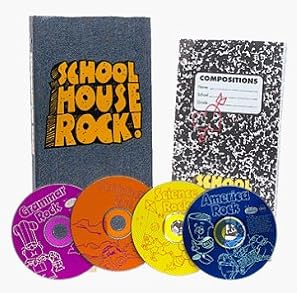
Cover of Schoolhouse Rock! (1973 TV Series)
Faith is a funny word. I don't mean funny in the sense that it makes you giggle when you say it (like 'dipthong') or that if you say it repeatedly it doesn't sound like a real word any more (like 'phalange'). What I mean is that the word 'faith' is one that carries multiple meanings. Sometimes it is hard to know just how a person is using the word in a given instance.
For example, we might talk about 'faith' categorically, such as, "There were many different 'faiths' represented at the community event." We might even be bold enough (since discussing religion and politics is culturally taboo) to ask someone, "Tell me about your 'faith' tradition, are you religious?"
We sometimes use the word faith in a quantitative sense, "It is going to take a lot of 'faith' for me to get on that airplane!" or "I couldn't muster up enough 'faith' to confront my boss."
The word 'faith' can also be used in contexts where someone's character is either being praised or scolded. You might know someone who visits the same coffee shop every day, at exactly the same time, and orders the exact same beverage. We call that person a 'faithful' customer. On the other hand a cheating spouse is labeled 'unfaithful' because of his or her marital misconduct.
I could go on with other examples but I will attempt to make my point. How do we know what people are talking about when conversations turn to the topic of 'faith'. What exactly does the victim of a terrible tragedy mean when they for example, say, "It was my 'faith' that carried me through this difficult time"? How should my congregation understand me when I tell them that the Bible says we are to be 'people of faith' or that a Christian is someone who has placed their 'faith' in Jesus Christ?
If we go back to our early days in school, when we were first taught English grammar we may remember hearing something about prepositions. Prepositions are those little words that typically point us to a location (yes, they can point to time and relationship too but bear with me). So when we first were learning to read we said that, "The cat is on the mat" or that we would not eat green eggs and ham "in a box or with a fox." (If you're still a bit rusty on prepositions be sure to review the classic episodes of School House Rock.)
Now if we are building a sentence to help us better understand what faith is we might say something like, "I (the subject) have (the verb) faith (the direct object) in (a preposition)..." What we need now is what our English teachers called "the object of a preposition."
You see, faith requires an object. You can't just have 'faith' by itself, that is unless you are talking about "the faith" as in "Keep the faith!" or you are talking about that girl whose name is Faith. Thanks to that little two-letter word "in" we know that there must be another noun (person, place or thing) that tells us where that faith is located.
We could say then that 'faith' is the trust that a person has in a certain object (something or someone) based on what they believe to be true about that object. For example, imagine you were about to board a flight at the airport when you notice that your pilot is yawning uncontrollably and is complaining to his co-workers about how he hasn't slept in days. Then you happen to notice out the window that someone appears to be patching up sections of the plane with duct tape. Would you take your seat? My guess is no, you would not deem this situation travel-worthy.
Now according to the Bible, both the Old and New Testaments (a claim that is worth verifying), the most worthy object of a person's faith is in God Himself and in His Son Jesus Christ. But that doesn't tell us much, does it? We might reply by asking, "Faith to do what? Why should I trust God? Why is Jesus worthy of faith?" Based on my definition of faith stated above we would have to somehow demonstrate that God and/or Jesus are worthy of faith by showing that we could trust them to do what they claim to be able to do for us because of what we believe to be true about them.
And that's what I hope to demonstrate next time. To be continued...
[This column was originally written for and published in the July 20, 2011 edition of the EV Star, North English, IA]


No comments:
Post a Comment